
Key Points:
- Punjab Higher Education Commission Chairperson Prof Dr Iqrar Ahmad Khan has warned that Pakistan’s population may double within half a century.
- He said rising youth numbers, child stunting, wasting and expanding population figures must serve as a wake-up call rather than cause for despair.
- UAF Vice Chancellor Prof Dr Zulfiqar Ali urged faster efforts against soil deterioration, post-harvest losses and for value-added products alongside digital farming.
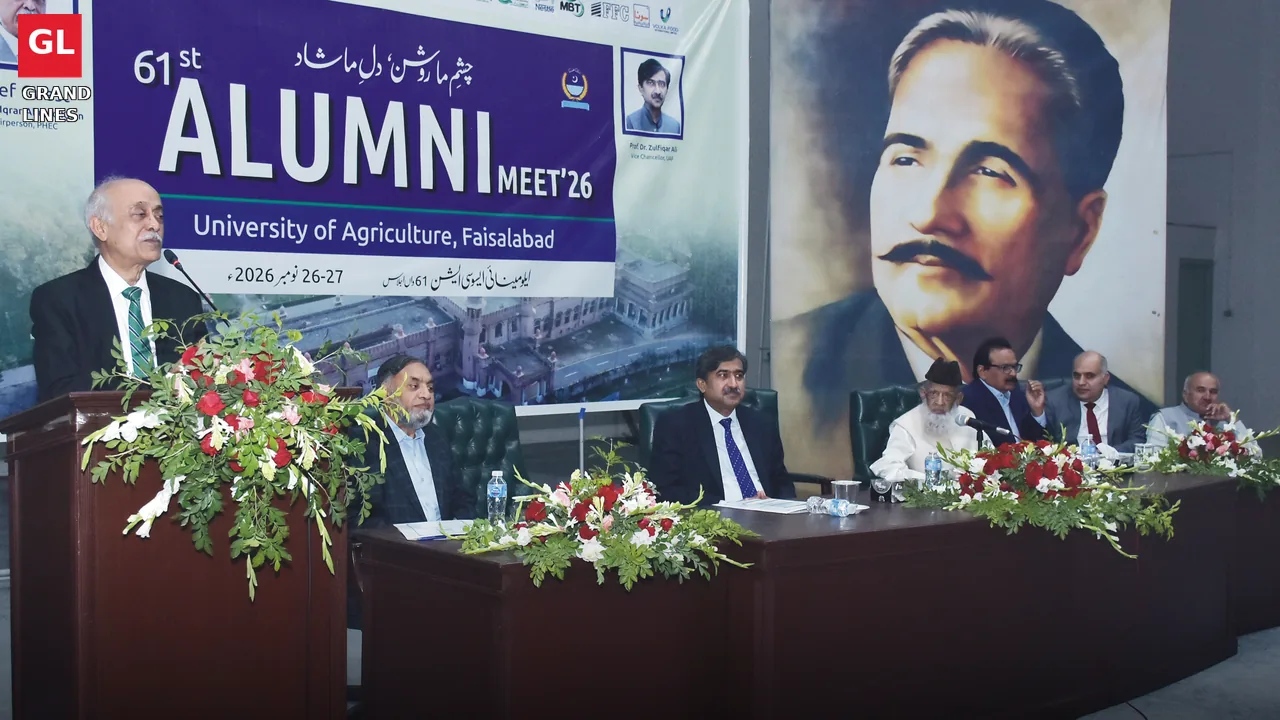
FAISALABAD: Pakistan’s population may double in half a century, deepening the threat from malnutrition, water scarcity and shrinking farmland.
According to the University of Agriculture Faisalabad handout, Punjab Higher Education Commission Chairperson Prof Dr Iqrar Ahmad Khan addressed the university’s alumni meet as chief guest on Thursday.
He said reports pointing to rising youth numbers, high rates of child stunting, wasting and expanding population figures must serve as a wake-up call rather than cause for despair.
Drawing on his memories of food shortages and rationing before the Green Revolution, he observed that low baseline yields and supply shocks have historically tested vulnerable populations.
Recalling an international forum and the legacy of Green Revolution pioneer Norman Borlaug, he pointed to the famines of the Second World War.
Scientific breeding, dwarfing traits and agricultural collaboration helped transform wheat productivity, including high-yielding varieties such as Maxipak in the 1960s.
 10,694 graduates receive degrees at UAF convocation
The PHEC chairperson praised the University of Agriculture Faisalabad for transforming the agriculture sector and called for restoring genuine mentorship in academia.
He observed that rigid metrics and rapid PhD expansion without matching research funding have strained higher education.
He recalled that earlier teachers offered mentorship and patronage without ostentation, whereas competing pressures and material pursuits have increasingly overshadowed the traditional stature of the teacher.
“Reports pointing to rising youth numbers, high rates of child stunting, wasting and expanding population figures must serve as a wake-up call rather than cause for despair.”
He also flagged the sharp rise in PhD production over roughly two decades without dedicated research funding, questioning the sustainability and quality of such expansion.
He urged universities and policymakers to prioritise substance, mentorship and realistic research support over purely numerical indicators.
University of Agriculture Faisalabad Vice Chancellor Prof Dr Zulfiqar Ali emphasised accelerating institutional and field-level efforts to combat soil deterioration, curb post-harvest losses and restore soil health.
He also called for promoting value-added agricultural products alongside digital farming and modern agronomic trends.
He noted that the university is actively integrating experimental and demonstration farms into its research and extension model.
The university operates six regional outposts across central Punjab, including Narowal, Hafizabad, Okara, Burewala and Depalpur, in addition to a dedicated community farm at the Postgraduate Agricultural Research Station.
These serve as vital hubs for technology transfer and farmer engagement.
He urged the alumni community, spanning academia, agribusiness, policymaking and progressive farming, to leverage their expertise and professional networks in partnership with their alma mater.
He stressed that collaborative efforts between university researchers, regional outposts and alumni are essential to translating laboratory innovations into climate-resilient, profitable practices at the grassroots level.
This would strengthen national food security and boost rural livelihoods.
Old Boy Hafiz Abdul Qayum briefed the gathering about the university’s history and how it transformed agriculture as the mother of all agriculture institutions in the subcontinent.
PARB CEO Dr Abid Mahmood, Lasbela University of Agriculture Vice Chancellor Dr Abdul Malik Tareen and Professor Emeritus Dr Khalid Mehmood also spoke.
Ghazi University Vice Chancellor Dr Ashfaq Ahmad, Dean Agriculture Dr Ghulam Murtaza and other notables also spoke at the meet.
Author Profile

- The Grand Lines covers news that impacts lives, uncovers truths, and keeps you fully informed.
Latest Entries
 FaisalabadNovember 26, 2026Monday shutdown to hit 66 feeders in Faisalabad region
- FaisalabadNovember 26, 2026Faisalabad Bypass to get safer in five days
- EducationNovember 26, 2026GCWUF students dress as art-history icons at exhibition
- CrimeNovember 26, 2026RPO opens Khidmat Markaz, hears citizens at Arroti