

By Ali Raza
Education is not just a subject; it is the foundation upon which the entire structure of a nation stands. Unfortunately, in Pakistan, this foundation has long been weakened by outdated practices, poor policy implementation, and lack of priorities.
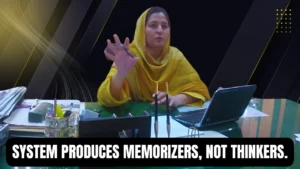
Dr. Bushra Naoreen, Head of the Department of Education at Government College University Faisalabad, said this while she was talking to Grand Lines.
Sharing her valuable insights on how we can improve our education system, she explained that the current system was designed decades ago.
Resultantly, it is just producing graduates who can memorize information rather than develop thinking skills, recall facts but not reasons and follow instructions but not innovate.
Shedding light on the role of education as a subject, she said that experts agree that the discipline of education is one of the most vital areas within any academic framework.
It covers all levels from pre-primary to university and includes everything from curriculum design, teaching methodology to assessment systems and policy formulation.
However, Pakistan’s education structure is deeply flawed, with systemic weaknesses, preventing it from serving its true purpose.
Flaws in the Curriculum and Rote Learning System
Dr. Naoreen said the curriculum of Pakistan itself has become a burden for young learners. A primary school child carries eight to ten books daily, most of which demand rote memorization rather than understanding.
Teachers are burdened by the pressure of syllabus completion and overcrowded classrooms. Due to these issues, they are finding it difficult to engage students in creative or activity-based learning.
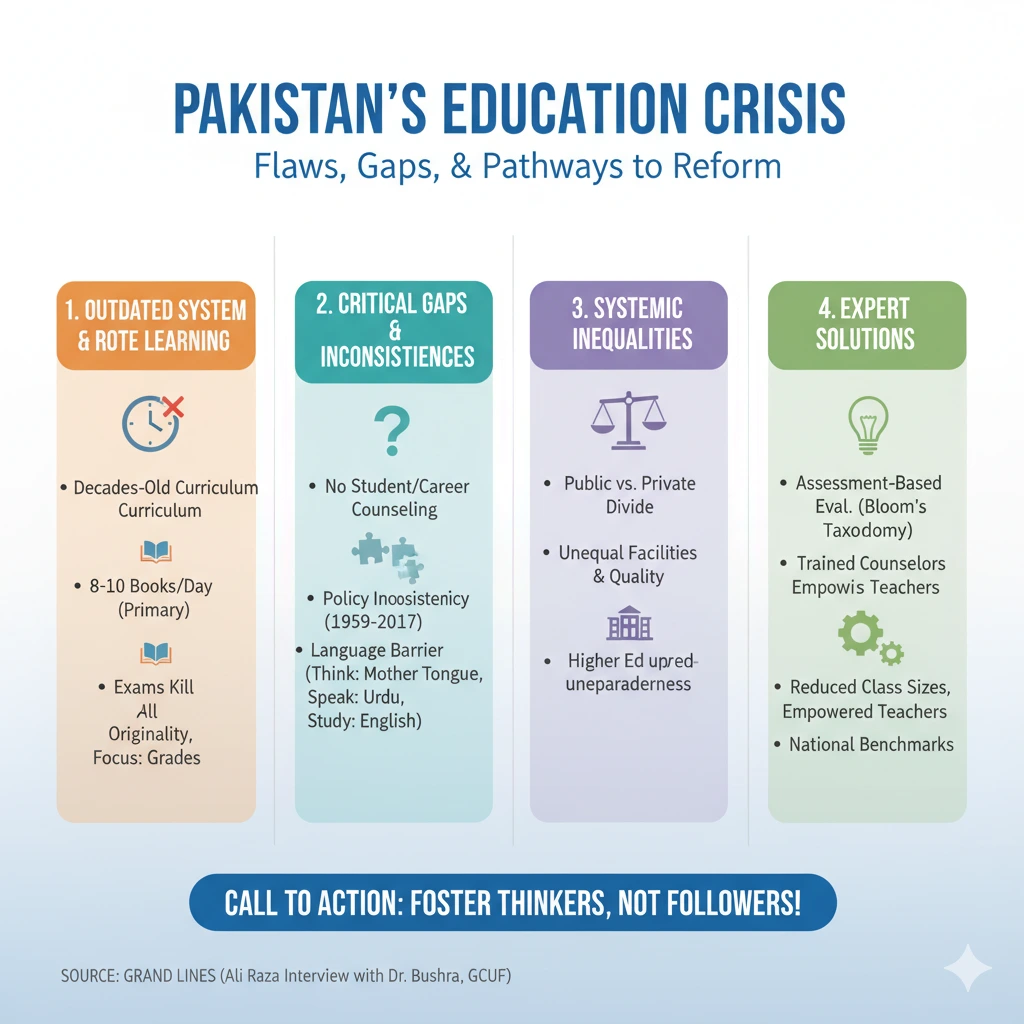
She also highlighted the greatest flaws in Pakistan’s examination system, which encourage students to memorize and reproduce rather than analyze and express. Due to this, she said, our education has become synonymous with repetition. Children are asked to memorize essays about “Ali and Ahmed” instead of writing about their own lives.
This system not only kills originality but also trains students to focus on grades instead of striving for knowledge. We have to reform our assessment methods, enabling students to develop projects that will ultimately foster out-of-the-box thinking, Dr. Naoreen suggested.
The Critical Need for Student Counseling and Career Guidance
Another critical gap, she explained, is the absence of student counseling and career guidance.
In most schools, parents dictate career choices without considering the child’s interests. It has also been observed that teachers, who spend six to eight hours daily with students, seem reluctant to be involved in these decisions.
We need to establish counseling sessions before ninth grade to help identify students’ natural abilities and guide them accordingly. Unfortunately, she said, this aspect is being ignored due to heavy teaching loads and a lack of trained counselors.
Policy Inconsistency and Disparity in School Systems
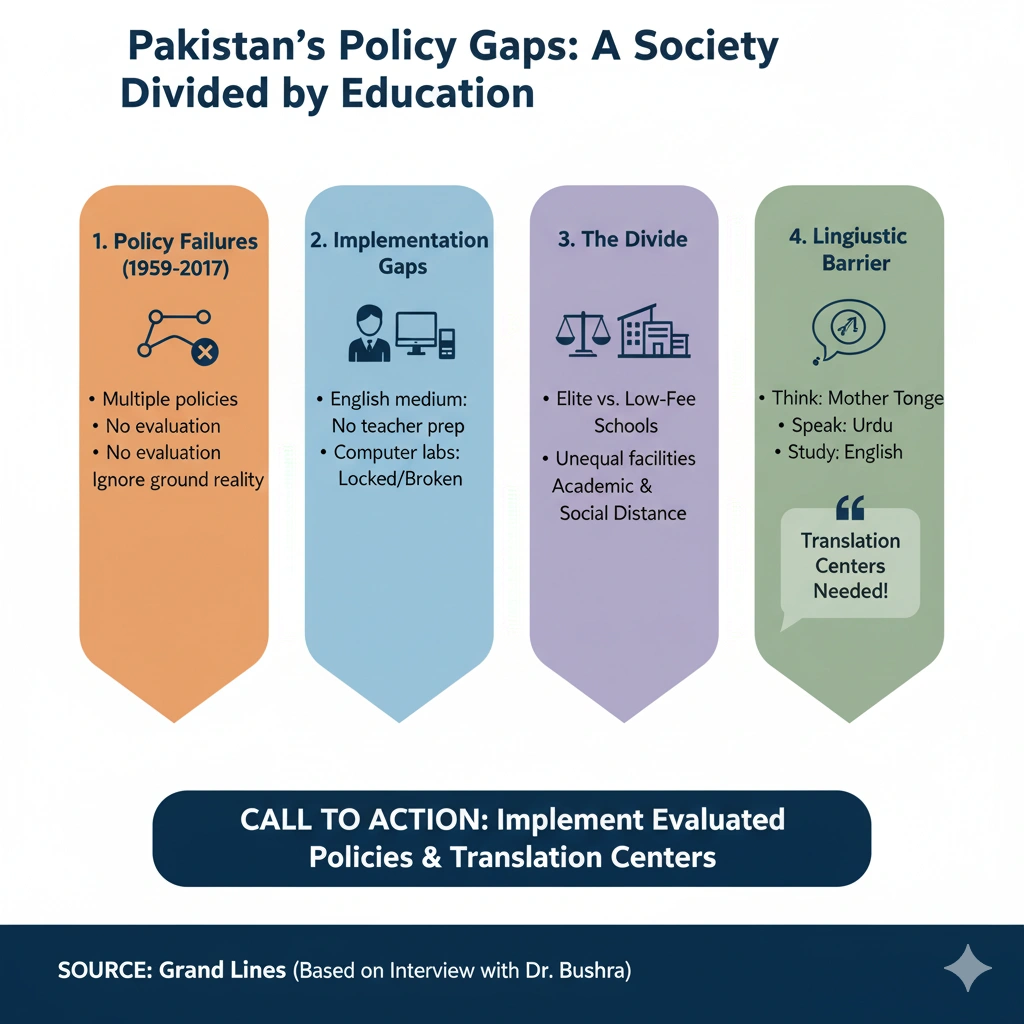
Talking about policy inconsistency, she said that this dilemma further worsens the problem. From 1959 to 2017, she said that multiple education policies have been introduced without evaluating the previous ones. Policies often fail, she claimed, because these have been formed while ignoring ground realities.
For instance, English was imposed as a medium of instruction at the primary level without preparing teachers. Similarly, computer labs were installed without technicians, leaving equipment locked or broken.
She said, the disparity between public and private education has also divided society. Elite schools offer a world-class experience, while government and low-fee schools struggle for even basic facilities. This inequality creates not just academic but also social distance among children, she claimed.
Moreover, forcing English as the medium of instruction has also added another barrier. Students think in their mother tongue, speak Urdu, and study in English, a linguistic conflict that leaves them confused and insecure.
“We have to establish translation centers that could play a key role in making global knowledge accessible in local languages.”
The Widening Gap in Higher Education Challenges
When she spoke about higher education, she categorically mentioned that this segment also faces similar challenges. University teachers often find that new students lack basic skills, from grammar to scientific understanding.
Years of rote learning leave them dependent on dictated notes and unwilling to think independently, she noted.
The first semester in most universities is spent just on improving the foundational standards of the students rather than advancing new ideas. The gap between intermediate and higher education continues to widen with every passing day, she added.
Expert Solutions for Pakistan Education Reform
Dr. Naoreen said experts have suggested several solutions that demand both vision and sincerity. The examination system must shift from memorization to assessment-based evaluation, following Bloom’s Taxonomy, which focuses on cognitive, affective, and psychomotor development.
“Schools need trained counselors to guide students before making career decisions. Class sizes should be reduced, and teachers should be empowered with training and time to connect with students,” she suggested.
She stressed the need for setting national benchmarks for all schools, regardless of class or region, that can help create uniformity in educational standards.
Language accessibility, equality in opportunities, and sincerity in action are key to any lasting solution. Without these, Pakistan’s education system will continue to produce followers instead of leaders, she lamented.
“It is time to realize that no nation can progress without thinkers, innovators, and responsible citizens. We can only create such persons through an education system that values understanding over memorization, curiosity over conformity, and learning over competition,” she concluded.
Author Profile
-
Ali Raza holds an MPhil in International Relations and is a vibrant journalist with a keen eye for global affairs. Beyond reporting, he is a passionate teacher, dedicated to inspiring students with critical thinking and a deep understanding of world events.
Ali combines his academic expertise with on-the-ground experience, delivering insightful analyses and thought-provoking stories that engage readers and learners alike.

Informative