
Key Points:
- Faisalabad’s air stayed very unhealthy or hazardous at every logged hour from 2 to 8 November; Monday opened at 391 in the hazardous band
- Of 77 hourly readings logged across the five fully recorded days, 42 crossed 200 and 13 crossed 300 into hazardous territory
- The week’s highest reading was 455 on Tuesday morning; its lowest, 155 on Saturday afternoon, still sat inside the unhealthy band
- The worst air arrived between 6:00 and 10:00 AM each day, the hours of the school run, the commute and the outdoor working day
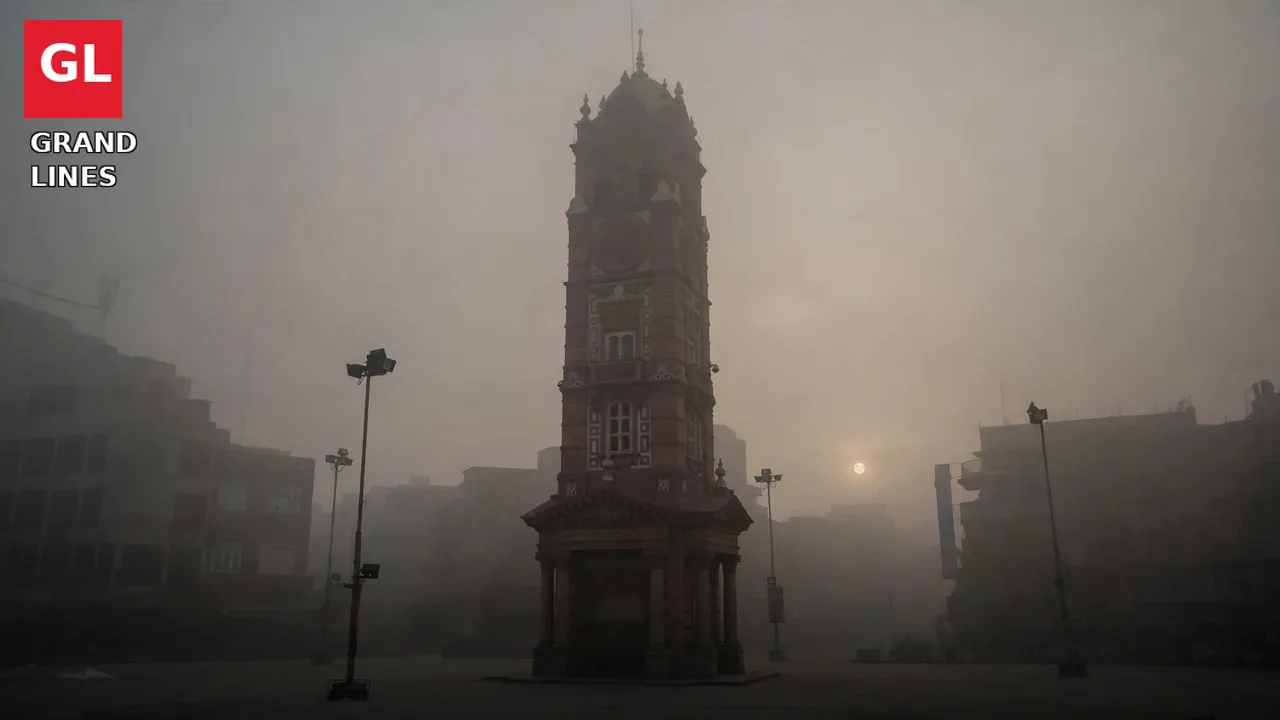
FAISALABAD: The city spent a week breathing very unhealthy or hazardous air and Monday opened dirtier at 391.
The figures come from Grand Lines’ own hourly log of IQAir Faisalabad readings, kept since 2 November and published on the city’s permanent Faisalabad air quality page.
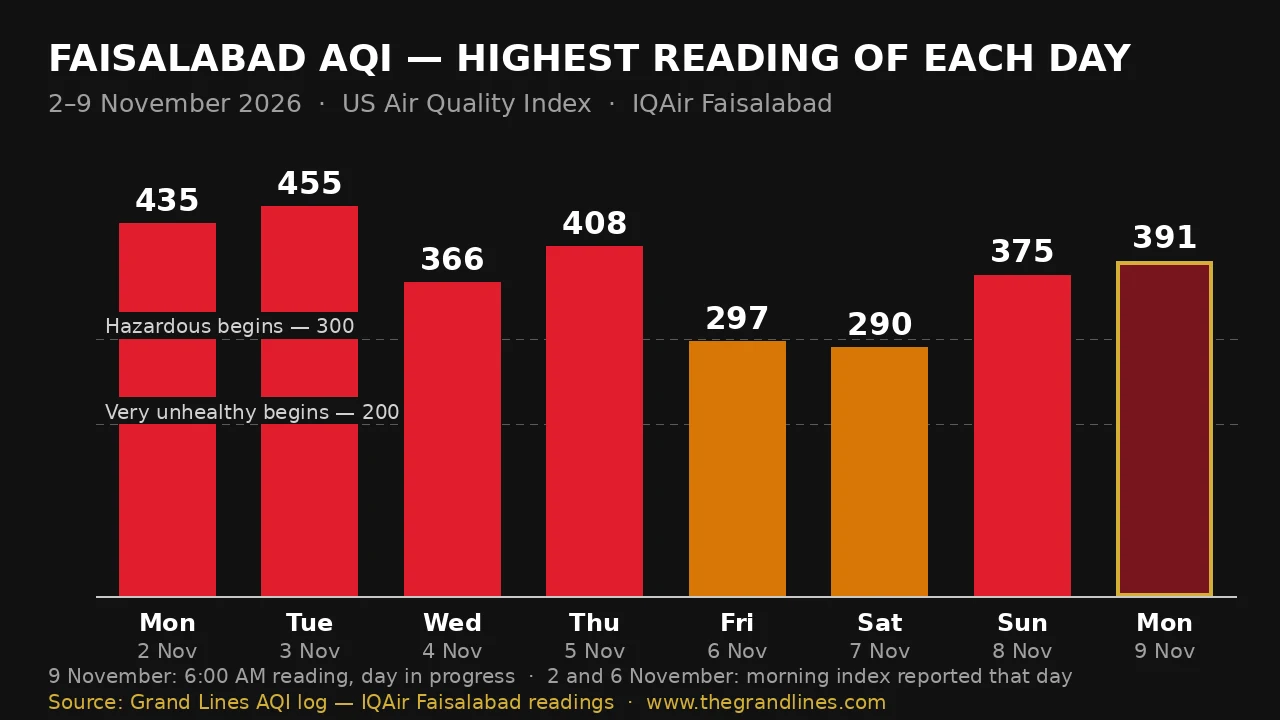
Tuesday 3 November was the week’s worst day, opening at 455 in the hazardous band at 9:00 AM, with 353 still recorded at 10:00 AM.
The index had eased to 175 by 2:00 PM but closed that day at 271, very unhealthy.
Thursday 5 November ran it close, recording five straight hazardous hours from 6:00 AM and a peak of 408 at 9:00 AM. The full hourly record of that day is published in our 5 November air quality report.
Sunday 8 November touched 375 at 9:00 AM after four hazardous morning hours and closed at 233. Wednesday 4 November peaked at 366 at 8:00 AM, before offices and schools had settled into the day.
The week had opened on Monday 2 November at 435, hazardous, while Friday 6 November stood at 297 on a day when the hourly log was interrupted.
Saturday 7 November was the mildest of the seven; even its peak of 290 at 8:00 AM sat in the very unhealthy band.
The pattern across the week never changed: the poison arrived with the morning. On every fully logged day the highest reading came between 8:00 and 9:00 AM, exactly when children leave for school and the city sets out to work.
Afternoons brought the week’s only relief, with readings dipping between 2:00 and 4:00 PM, yet the lowest, 155, never left the unhealthy band. By 9:00 PM the index had climbed back above 230 on every logged day, so the city slept in dirty air.
The five 9:00 PM closes — 271, 245, 246, 238 and 233 — all sat in the very unhealthy band. The afternoon lows, 174 to 180 on the midweek days, never reached the moderate band either.
For rickshaw drivers, traffic wardens, vendors and labourers, the peak hours are working hours spent outdoors on the street. Office staff reach shelter by mid-morning; the street trades breathe the worst of the day in full.
“On every fully logged day the highest reading came between 8:00 and 9:00 AM, exactly when children leave for school and the city sets out to work.”
The bands are not abstractions: an index from 201 to 300 is rated very unhealthy and carries a health alert for the whole population. Anything above 300 is hazardous, the emergency band in which everyone is advised to stay indoors where possible.
The driving pollutant is PM2.5, fine dust that lodges deep in the lungs, with morning concentrations running from 208 to 293 micrograms per cubic metre. Punjab’s own standard allows 35 over 24 hours, so those mornings carried six to eight times the provincial standard.
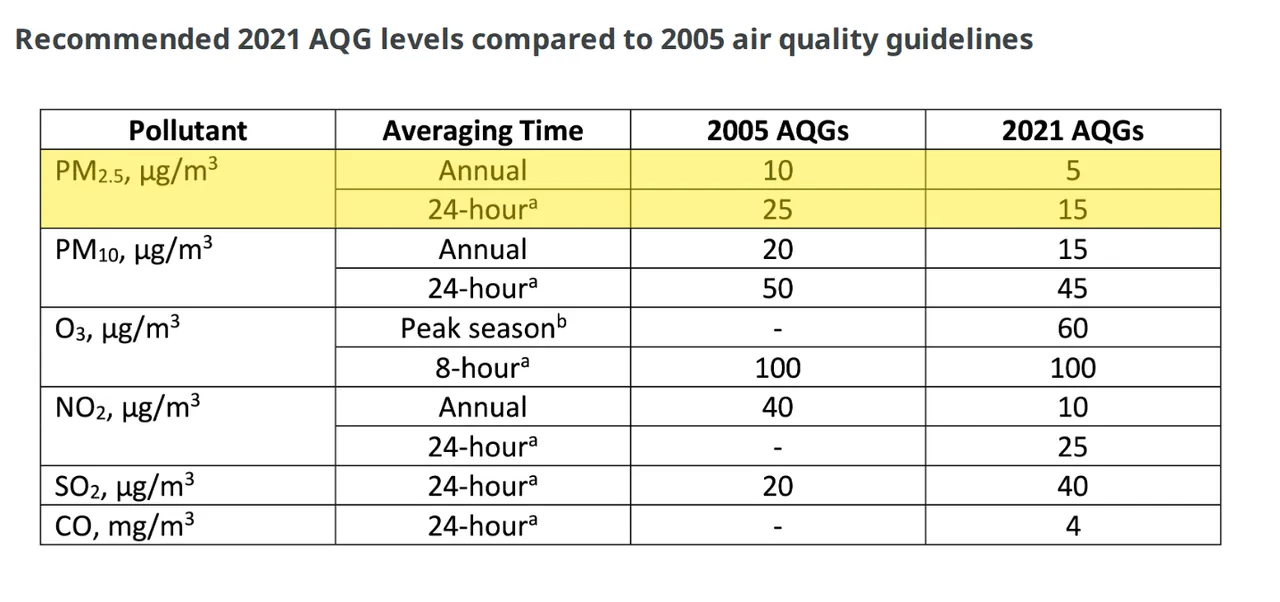
The World Health Organization sets its 24-hour guideline at 15 micrograms, so the week’s mornings ran at roughly fourteen to twenty times that level.
Crop residue burning is the season’s most visible suspect. The warnings against it ran all week, led by the Punjab Agriculture Department, which warned paddy farmers against burning stubble after harvest and called it a punishable offence.
The department said 10,000 super seeders had gone to farmers this year at 60 per cent subsidy under the chief minister’s smog control programme, costing Rs5.5 billion. It said burning destroyed the organic matter in the soil’s top layer and cut its fertility.
Farmers were advised to mix the residue into the soil with a rotavator or a disc harrow and to prefer a super seeder for wheat sowing.
Children, older people and patients with breathing or heart disease carry the highest risk on such mornings. Young lungs breathe faster than adult lungs; damaged lungs have no reserve when the air itself turns hostile.
On Friday, Faisalabad Commissioner Dr Imran Hamid Sheikh ordered faster and result-oriented anti-smog action across the division. He sought daily action reports from the Revenue Department, the Environmental Protection Agency and the Agriculture Department.
Revenue staff were told they would answer for any crop residue burned on their watch. District anti-smog committees were ordered to meet in all four districts of the division and send their minutes to the Commissioner Office.
At Thursday’s divisional review of the chief minister’s key performance indicators, the EPA was told to speed up inspections in a strict crackdown on crop-residue burning. Every open plot in the division was also ordered cleared of garbage.
On Saturday, Commissioner Dr Imran Hamid Sheikh banned dry sweeping across the division with immediate effect, after seeing sanitation staff sweeping Millat Road dry during his visit. He said the practice threw dust back into the air and warned that no violation would be tolerated.
The readings since those orders tell their own story: Saturday peaked at 290, Sunday at 375 and Monday opened at 391, hazardous. The questions the week puts to the EPA’s Faisalabad office and the district administration are therefore plain ones.
How many brick kilns, factories and smoke-emitting vehicles were penalised during the week? What did the daily action reports ordered on Friday actually contain?
Were schools sent any health advisory on the hazardous mornings, when children travel through the worst air of the day?
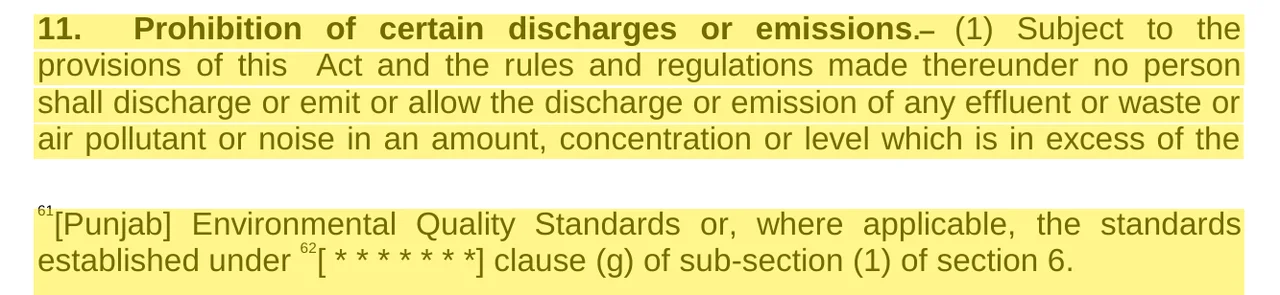
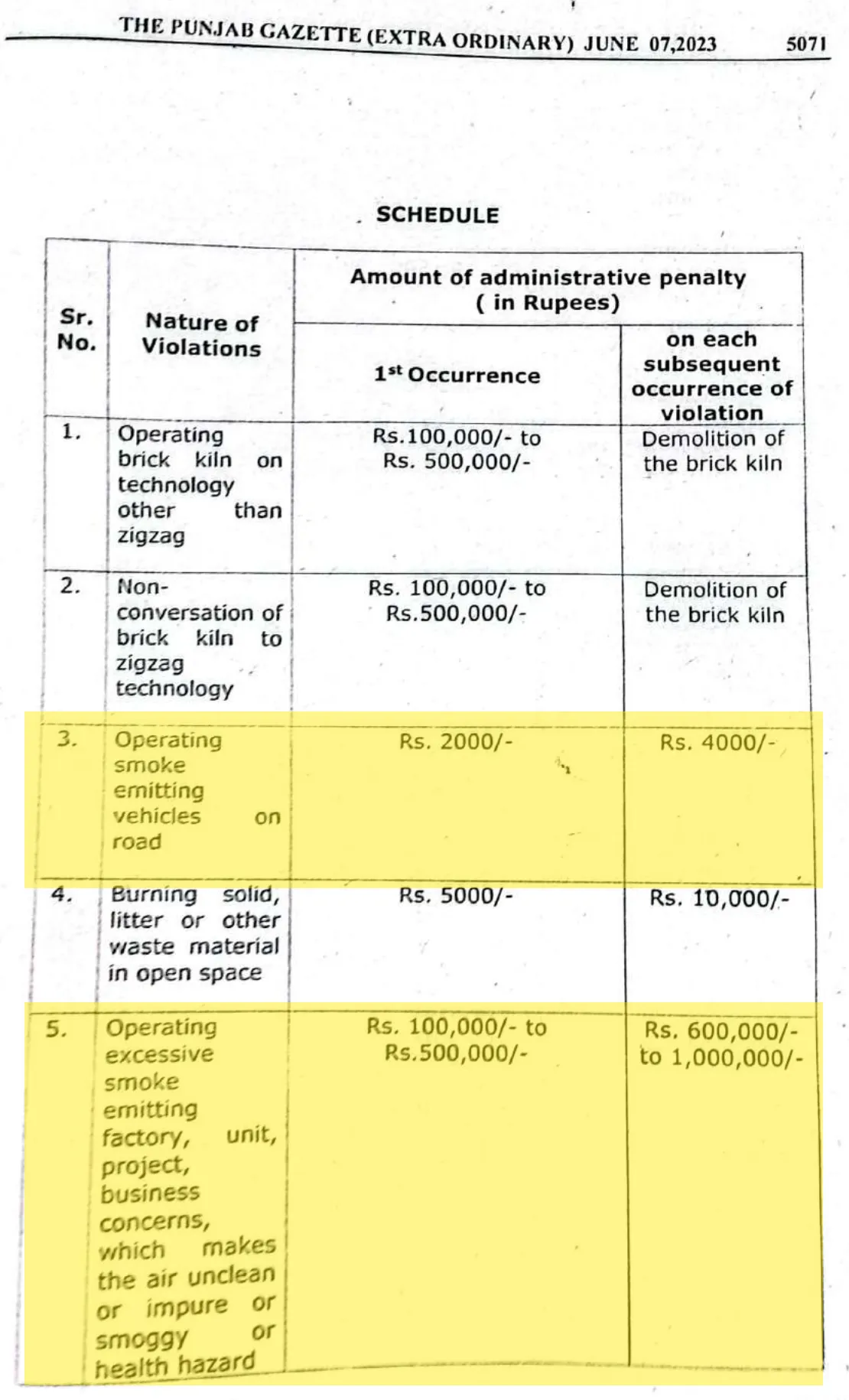
The legal yardstick exists: section 11 of the Punjab Environmental Protection Act 1997 bars emissions beyond the Punjab Environmental Quality Standards. The Smog Prevention and Control Rules 2023 fix penalties from Rs2,000 for a smoke-emitting vehicle to Rs500,000 for a factory emitting excessive smoke.
Until the pattern breaks, the advice in our daily reports holds: avoid outdoor exertion on very unhealthy and hazardous mornings, wear a mask outdoors and keep windows shut. Children and patients should stay indoors at peak hours where possible; indoor air cleaning helps where available.
Monday’s opening reading of 391 means an eighth straight morning has begun in the very unhealthy band or worse. Faisalabad is not waiting for its smog season to arrive; by the city’s own log, it is already living in it.
Read More: Revenue Staff to Answer for Residue Fires, Commissioner Warns
Author Profile

- Award-winning investigative journalist with 20+ years of experience across Pakistan's leading news organisations, including 15+ years as Senior Staff Correspondent at Dawn. Driven by a lifelong passion for investigative journalism and human rights, with a proven record of hard-hitting stories that forced official action — from hospital negligence and illegal land grabs to harassment probes and social injustice. He is the recipient of the K.C. Kulish International Award for Excellence in Print Journalism.
Latest Entries
 FaisalabadNovember 9, 2026Not One Clean Hour: Faisalabad’s Week in Very Unhealthy Air
- ExclusiveNovember 4, 2026A Stitch in Time Saves a ‘Life’
- FaisalabadNovember 1, 2026367 of 794 Housing Schemes Illegal in Faisalabad
- CrimeOctober 25, 2026Eight Days On, Faisalabad Murder Case Awaits Official Word